




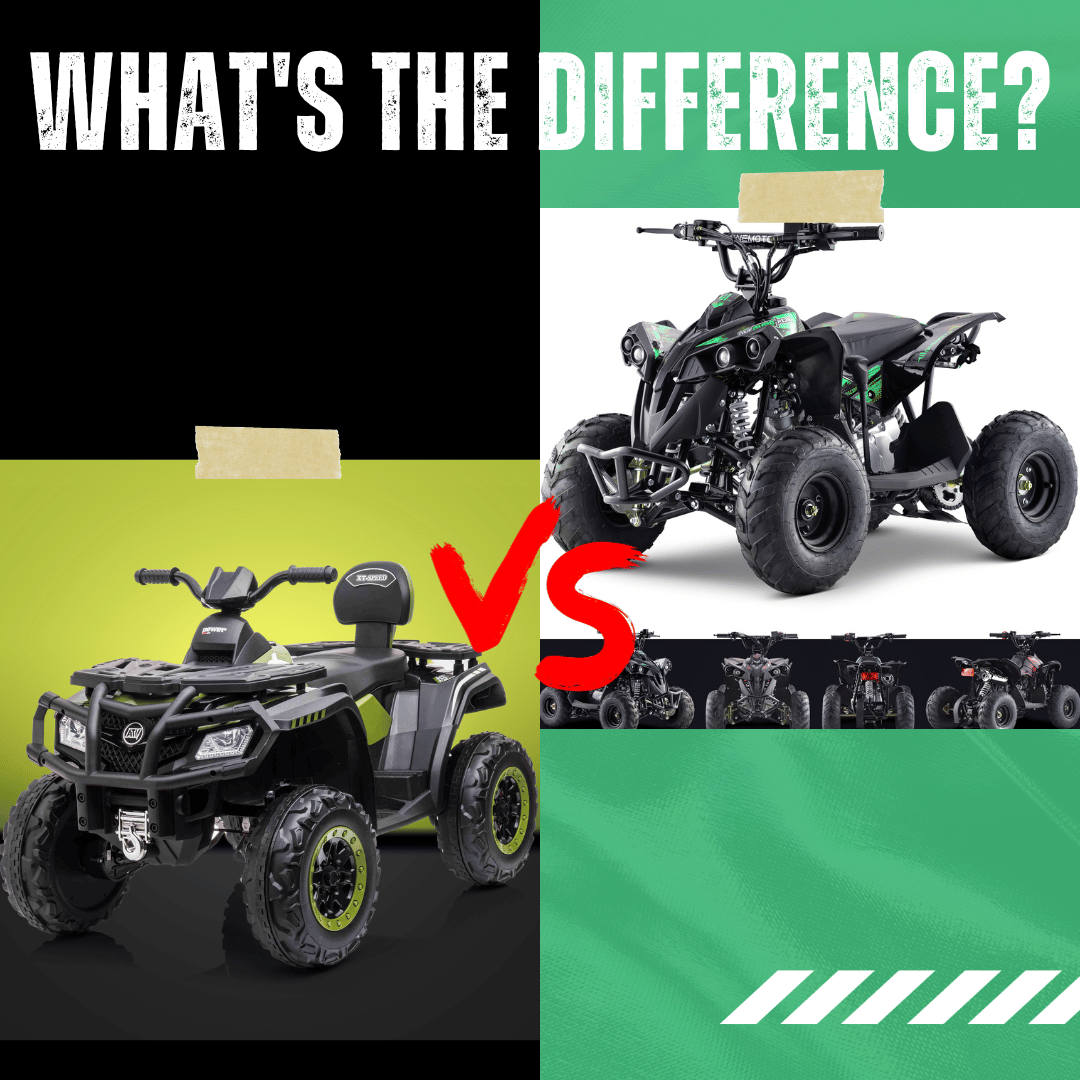
Quick answers first. ATV and quad bike are two names for much the same thing. "ATV" (all-terrain vehicle) is the general term; a "quad bike" is the common UK name for the four-wheeled kind you sit astride and steer with handlebars. Electric or petrol? Electric quads are quieter, simpler and cheaper to run; petrol quads give more power and range but need fuel and servicing. Petrol quads are for private land only, and children must always be supervised and wear a helmet and protective gear.
ATV vs quad bike
- ATV (all-terrain vehicle) is the general term for these off-road machines.
- Quad bike is the name for the four-wheeled ATV: a saddle-style seat, handlebars and four low-pressure tyres. In everyday UK use people say "quad", "quad bike" and "ATV" interchangeably.
- Side-by-side, UTV or buggy is different: two seats side by side, a steering wheel and often a roll cage. See kids' UTVs and buggies.
- Dirt bike has two wheels. See dirt bike vs ATVs.
Types of quad and ATV
| Type | What it is |
|---|---|
| Electric quad | Battery and motor, quiet, no fuel. Kids' models run from 6V up to 48V |
| Petrol quad | Engine of 50cc and up, with automatic, semi-automatic or manual gears |
| Sport quad | Performance suspension, higher ground clearance, sharper styling |
| Utility quad | Built for durability, with racks and sometimes towing |
| Youth quad | Smaller, speed-limited models sized for children |
| Side-by-side (UTV) | Two seats, steering wheel, roll cage |
Browse quad bikes and ATVs.
Electric vs petrol quad bikes at a glance
| Electric | Petrol | |
|---|---|---|
| Power source | Rechargeable battery and motor | Engine, 2-stroke or 4-stroke |
| Noise | Quiet | Loud |
| Emissions | None from the quad | Exhaust gases |
| Maintenance | Few moving parts; battery care | Oil, filters, coolant, brake fluid, fuel |
| Acceleration | Instant torque | More gradual build-up |
| Power and range | Limited by battery, long recharge | More power, quick to refuel |
| Running costs | Charging is usually cheaper | Fuel and servicing add up |
| Upfront price | Can be higher for some models | Often lower for the same power |
Electric quads
Electric quads are powered purely by rechargeable batteries. They are quiet and responsive, have fewer moving parts and need little maintenance, and they produce no exhaust fumes. Charging is usually cheaper than refuelling over time. The trade-offs are limited range per charge, longer recharge times, battery replacement eventually (the manuals for our OneMoto electric quads give an average battery life of 1 to 2 years, depending on use) and the need for correct charging and storage.
Petrol quads
Petrol quads are the traditional choice: a roar you can hear, quick to refuel and more power and range than their electric siblings. Engine sizes in our range run from 50cc to 250cc. They need regular care: oil, filters, coolant and brake fluid, and they carry more noise, emissions and spill risk. Read how to service your quad bike at home.
Pros and cons side by side
- Electric: instant acceleration, quiet ride (easier to talk and hear around the quad), simple controls and no engine warm-up, which suit beginners. Cons: limited range, charging access, battery replacement.
- Petrol: greater range and easy refuelling, more mechanical feel, more raw power. Cons: pollution and noise, higher running costs and more complex maintenance.
Our quads in stock
Petrol quads are for private land. The age is from each quad's manual; "not in manual" means the manual we hold gives no age, or there is no manual in our product data. Prices and stock checked on 19 November 2026. Browse electric quads and read what size quad bike do you need for sizing and weight limits.
| Model | Power | Age (manual) | Top speed (listing) | Price |
|---|---|---|---|---|
| RiiRoo ShadowForce 12V | 12V | 3 to 8 years | 5 km/h (3 mph) | £109 |
| RiiRoo 24V Ride-On Quad ATV | 24V Parallel | 3+ | 5 km/h (3 mph) | £229 |
| RiiRoo 24V Fortress Quad ATV | 24V | 3 to 8 years | 5 km/h (3 mph) | £229 |
| Licensed Can-Am Maverick ATV 24V | 24V | 3 to 7 years (37-95 months) | 8 km/h (5 mph) | £229 |
| Licensed Can-Am Outlander ATV 24V | 24V | 3 to 7 years (37-95 months) | 8 km/h (5 mph) | £299 |
| OneQuad EX1S | 36V 1000 W | 12+, adult supervision under 16 | 28 km/h (17 mph) | £449 |
| OneQuad EX2S | 36V 1000 W | 12+, adult supervision under 16 | 28 km/h (17 mph) | £529 |
| OneQuad EX4S | 36V 1000 W | not in manual | 35 km/h (22 mph) | £459 |
| OneQuad EX3S | 48V 1200 W | 16+ | 38 km/h (24 mph) | £739 |
| OneQuad PX1SX | 50cc petrol | not in manual | 40 km/h (25 mph) | £349 |
| OneATV PX1S | 50cc petrol | 12+, adult supervision under 16 | 40 km/h (25 mph) | £329 |
| OneATV PX3S | 110cc petrol | not in manual | 55 km/h (34 mph) | £679 |
| 125cc Quad/ATV | 125cc petrol | 16+ | 55 km/h (34 mph) | £1140 |
| OneQuad PX8S | 200cc petrol | 16+ | 65 km/h (40 mph) | £1589 |
| OneATV PX6S | 250cc petrol | 16+ | 60 km/h (37 mph) | £1889 |
Safety and supervision
Safety concerns are greater with petrol quads because fuel is flammable, so store and handle it carefully. Electric quads have fewer immediate concerns, but supervision matters just as much, especially for younger children or beginners.
Essential gear: a helmet that meets the safety standard, eye protection, long sleeves and trousers, over-the-ankle boots and gloves.
Pre-ride checks (T-CLOC): tyres and wheels, controls and cables, lights and electrics, oil and fuel, chassis and chain.
Riding tips: keep a good posture, shift your weight into turns, stand on rough ground and practise at low speeds first.
Key safety rules:
- No riders under 16 on adult ATVs: our larger petrol quad manuals say a child under 16 should never operate them.
- Never ride on public roads.
- One rider only, no passengers.
- Always ride sober.
- Stay on designated trails and land where you have permission.
Also: right size for the rider, appropriate terrain, training, and regular maintenance. See understanding kids' quad bike safety features and quad bikes and the law.
Running costs
Petrol quads are often cheaper to buy, but fuel and regular maintenance raise the running cost over time. Electric quads can cost more up front for some models, but charging is usually cheaper than petrol, and fewer moving parts mean less maintenance, so they can save money in the long run.
Lifespan and durability
Electric quads have fewer parts that can go wrong: no exhaust, no radiator, and battery care and occasional battery replacement are the main concerns. Petrol engines are more complex and need diligent maintenance. With regular checks, both can give years of reliable service; the care it gets and the build quality matter most.
Electric or petrol? How to choose
Electric champions the environment and suits beginners; petrol offers raw power and a traditional feel. Think about the rider's age and experience, where you will ride, how much maintenance you want to do and your budget.
FAQs
What is the difference between an ATV and a quad bike?
In everyday use, none: "quad bike" is the four-wheeled kind of ATV.
Are electric quad bikes suitable for kids?
Yes. They are quieter, easier to control and many have speed limiters. Check the age in the manual: 3+ on our small battery quads, 12+ or 16+ on the OneMoto models.
How long do electric quad batteries last?
The manuals for our OneMoto electric quads give an average of 1 to 2 years, depending on use and charging habits.
Do petrol quads need more servicing?
Generally yes: oil changes, filters and tune-ups.
Can I ride electric quads in wet conditions?
Follow the manual for your model and keep out of deep water and puddles.
Is there a big price difference?
The upfront price can be higher for electric, but running costs are often lower.
Can electric quads handle mud like petrol ones?
Check the manual for your model before riding in mud or wet ground.
Are there age-specific models in both?
Yes. See the table above for the age in each manual.

Share:
Is It Ok To Start Quad Bike With Choke?
How Fast Does A 160cc Pit Bike Go?